Packing
Essential Items for Moving
The supplies that actually decide how a move goes — with real sizes, real quantities, and the short list of things worth buying instead of improvising.

Most people underestimate two things about moving: how much a home actually holds, and how much of moving day is decided by small, cheap items. The right tape gun saves an hour. The wrong box under a stack of dinner plates costs you the dinner plates.
This is the list we would give a friend. Not a catalog — a working kit, with sizes, quantities, and the reasoning behind each item, so you can walk into a supply store once and walk out done.
One note before the list. Free boxes from behind a grocery store are a false economy. They have been stacked in damp, they have been cut open, and their flaps have already been folded past the point where the corrugation holds. A box only carries weight through its vertical flutes and its corners. Once those are crushed, the box is a bag.
Buy these first
There is a version of this list that runs forty items long. Here is the version that matters. If you had one trip and one cart, this is what goes in it.
Everything else on this page is refinement. This is the part where skipping an item costs you real time on move day.
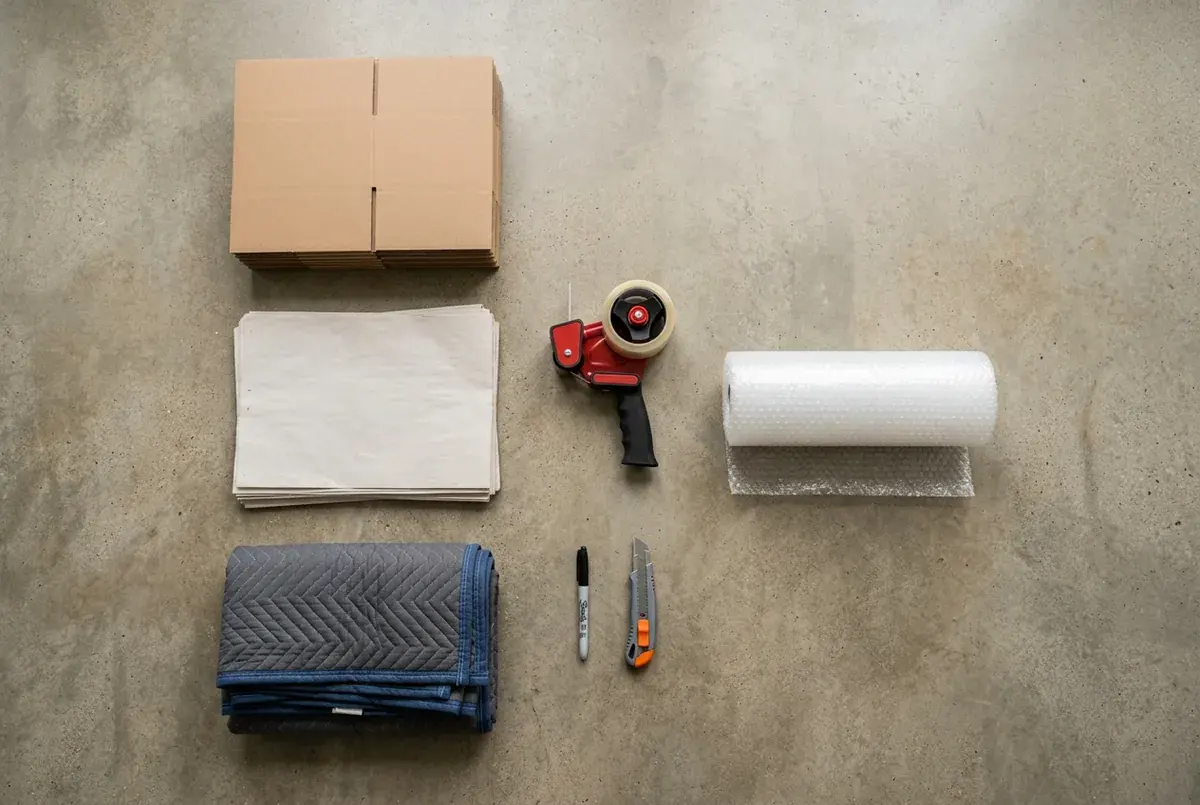
- A tape gun with a serrated blade, plus six or more rolls of two-inch clear packing tape. Not office tape, not duct tape, not masking tape — duct tape adhesive lets go in a hot truck and leaves residue on the carton.
- Two ten-pound bundles of clean newsprint packing paper. Newspaper ink transfers onto china, white ceramic, and unglazed pottery, and it does not come back off.
- One roll of eighteen-inch stretch wrap for drawers, cords, lids, and anything that wants to swing open mid-carry.
- Small boxes, roughly twice as many as you think you need. Heavy things go in small boxes. That is the entire rule, and almost every packing failure is a violation of it.
- A fat black marker on a lanyard or a loop of string. A marker you set down is a marker you have lost.
- A retractable box cutter and a roll of blue painter's tape, for labeling surfaces you do not want to write on.
- Four furniture sliders and four ratchet straps. Together they cost less than one gouged floorboard or one dented tailgate.
Boxes: four sizes do nearly all the work
Movers size boxes by volume, not by dimension, which is why you will see cubic feet on the side rather than inches. What matters to you is the pairing of volume and density: a large box is for bulky and light, a small box is for dense and heavy. A large box packed with books weighs more than most people can safely lift, and its bottom seam will fail somewhere between the hallway and the truck.
Keep a loaded carton under about fifty pounds. A book box that feels reasonable at forty pounds feels very different on the twelfth trip down a flight of stairs.
Fill to the top every time. A box with a hollow at the top will collapse under whatever gets stacked on it, and a box with rattling space inside lets its contents beat against each other for the whole drive. Crumpled paper is not filler, it is structure.
Small (book box)
1.5 cu ft, 16 x 12 x 12 in — books, records, canned goods, tools, hardware
Medium
3.0 cu ft, 18 x 18 x 16 in — the everyday workhorse; pantry, toys, small appliances
Large
4.5 cu ft, 18 x 18 x 24 in — linens, lampshades, anything bulky and light
Extra large
6.0 cu ft, 24 x 20 x 24 in — pillows, comforters, cushions, and nothing heavier
Dish barrel
5.2 cu ft, 18 x 18 x 28 in, double-wall — china, stemware, glass, ceramics
Wardrobe
14 cu ft, 24 x 21 x 48 in with a steel bar — hanging clothes, uniforms, drapes
How much tape, paper, and wrap to actually buy
The most common supply mistake is buying a sensible-looking amount of everything and then making three more trips during the week you have the least time. Buy long, and return what you do not open.
The figures below are planning estimates for a typical two-bedroom home. Scale down for a studio, and add roughly half again for a three-bedroom with a full garage. A kitchen alone will consume more paper than the rest of the house combined.
Packing paper
Two 10 lb bundles, roughly 300 to 400 sheets — the kitchen eats most of the first one
Packing tape
6 to 8 rolls of 2 in x 55 yd; one roll seals roughly fifteen boxes properly
Bubble wrap
One 100 ft roll of small-bubble for fragiles, plus a short roll of large-bubble for electronics
Stretch wrap
One 18 in x 1,000 ft roll for drawers, sofa cushions, and cable bundles
Moving blankets
12 to 18 pads; add more if you own a piano, a stone table, or a large TV
Mattress bags
One per mattress and one per box spring, 5 mil thickness, not the thin dry-cleaner type
Let us do the supply math.
Walk us through the rooms and the stairs and you get one number, locked, before a single box is taped.

The specialty items worth buying instead of improvising
Six items do a specific job that no amount of newspaper and hope will replicate. Each of them exists because a particular category of belonging breaks in a particular way.
A dish barrel is double-walled for a reason. Plates travel on edge, standing vertically like records in a crate, each one wrapped individually and then bundled in threes. Flat-stacked plates crack because the load transfers through their centers. On edge, the force runs through the strongest part of the plate.
Framed art and mirrors go in telescoping picture cartons with foam corner protectors, never face to face without a spacer between them. Run tape across the face of mirror glass in a wide X. That does not prevent a break, but it holds the shards together if one happens, which is the difference between a bad afternoon and a trip for stitches.
Televisions ride upright, always. A panel laid flat flexes across its own diagonal every time the truck hits a seam in the freeway, and the failure shows up as a line of dead pixels a week later. If you kept the original carton with its molded foam, this is the day it earns the closet space it has been occupying.
- Dish barrels with cell dividers for stemware, and foam pouches for anything with a stem or a handle
- Telescoping mirror and picture cartons, plus foam corner protectors
- A television box, or the original carton, and a soft cloth for the screen face
- Heavy mattress bags in 5 mil, taped closed at both ends
- Wardrobe boxes, which double as fast, no-fold packing for closets and for dress uniforms
- Sealable plastic bins for anything that must stay dry, and for the garage items you will unpack last
Labeling: fifteen minutes that saves you a weekend
Label the side of the box, not the top. Once boxes are stacked three high in a garage, the tops are invisible and you will end up opening things at random to find the coffee filters.
Write three things on two adjacent sides: the destination room, two or three words of contents, and a number. Keep the numbers in a note on your phone with a slightly longer description. Numbering costs seconds per box and turns the question of where something is into a search rather than an excavation.
Buy colored tape in one color per room and put a matching strip on the doorframe at the new place before the truck arrives. A crew that has never seen your floor plan will place every box correctly without asking, which is worth more than it sounds like when there are four people carrying at once.
Mark FRAGILE and THIS SIDE UP on the sides, not the lid, and reserve one clear label — OPEN FIRST — for the two or three boxes that hold the first evening's needs.
San Diego adds its own items to the list
The coast makes specific demands. In La Jolla, the streets off Nautilus and through Bird Rock are narrow enough and the driveways steep enough that a full-size truck often cannot stage at your door, which means a longer carry from wherever it can legally park. Add extra floor runners, a hand truck with pneumatic wheels rather than hard plastic, and wheel chocks if anything is being loaded on a slope. Long carries also mean more handling per item, which means padding matters more, not less.
Downtown and Mission Valley high-rises run on reservations. Most buildings require a booked freight elevator window and a certificate of insurance naming the building and its management company before they will hand over the elevator key. Ask the management office what they need, and give them the mover's USDOT number when they ask for it — ours is 4329208, we are licensed and insured, and we carry one million dollars in liability coverage with one hundred thousand in cargo coverage, which is what those forms are asking about. Check the garage clearance too. Plenty of San Diego parking structures will not admit a box truck, and that is better discovered a week early than at eight in the morning.
Heat is the quiet one. A closed trailer parked in the sun on an inland run toward El Cajon or Santee gets far hotter than the air outside. Candles, crayons, vinyl records, chocolate, cosmetics, pressed supplements, and most medications should ride in your own car with the air conditioning on. On the coast the opposite applies in the morning: the marine layer leaves driveways damp, and cardboard left sitting on wet concrete softens at the corners within an hour. Stage boxes on a tarp or a pallet, not on the ground.
For a PCS move out of Coronado or Miramar, keep your own numbered inventory alongside the official one and photograph high-value items before they are wrapped. Box and label professional gear separately from household goods rather than mixing them, and use wardrobe boxes for dress uniforms so they arrive hanging instead of creased. Orders, medical records, and anything you would have to explain the loss of should travel on your person. If your report date lands on a holiday or a Sunday, that is workable — we run 24/7, holidays included.
We have done this street before.
Long carries, steep driveways, booked elevators and building paperwork — 10,000+ moves in, none of it is new to us.
The box you never load
Pack one bin that rides in your own vehicle and never touches the truck. Not because a mover will lose it, but because at nine at night in an empty house, you should not be opening boxes to find a phone charger.
This bin holds the essentials for the first twenty-four hours plus the items that should not be handed to anyone: passports, birth certificates, titles, the folder of closing or lease documents, prescriptions, jewelry, cash, keys, and laptops.
Separately, there is a short list of things that legally cannot go on a moving truck, and knowing it now avoids an argument later. Propane tanks, gasoline, kerosene, charcoal lighter fluid, aerosols, paint and paint thinner, pool chemicals, fertilizer, ammunition, fire extinguishers, and automotive batteries all stay behind. Drain the gas from the mower and the trimmer a few days out so the tanks have time to air.
Perishable food is the other one. Empty and defrost the refrigerator at least a full day ahead, prop the door open so it dries, and give away the freezer contents rather than gambling on how long a cooler holds temperature during a coastal-to-inland drive.
- Phone chargers, a power strip, and a small flashlight
- Toilet paper, paper towels, hand soap, and a shower curtain with rings
- One set of sheets and one towel per person, packed together so nobody hunts
- Basic tools: screwdrivers, an adjustable wrench, an Allen key set, scissors
- Trash bags, a box cutter, cleaning spray, and a sponge
- Medications, pet food and bowls, and a day of clothes per person
- Documents, valuables, keys, and anything irreplaceable
What to remember
- Heavy in small boxes, light in large boxes. Nearly every broken carton and strained back traces back to breaking that one rule.
- Buy more small boxes, more tape, and more paper than seems reasonable. Running out mid-week costs far more than the return trip.
- Plates travel on edge in a double-wall dish barrel, televisions travel upright, and framed art travels with corner protectors and a spacer.
- Label the sides of boxes with room, contents, and a number, and put matching colored tape on the doorframes at the new place.
- Reserve the freight elevator and confirm the building's certificate of insurance requirements early, then keep heat-sensitive items and documents in your own car.
Get it priced to the dollar.
No fuel surcharges. Stairs are in the quote. No hidden anything. The quote is the price, 24/7 including holidays.
As a planning estimate rather than a promise: a studio or one-bedroom usually lands somewhere around twenty-five to thirty-five boxes, a two-bedroom around forty to sixty, and a three-bedroom with a garage can run past eighty. Weight it toward small and medium sizes. A useful check is to walk each room and count shelves, cabinets, and drawers rather than furniture, since the storage is what fills cartons.
Ask your mover what padding travels with the truck. Most professional crews carry their own furniture pads and wrap and handle that part for you. If you are renting a truck and doing the load yourself, buy or rent the pads. Bare furniture in a moving truck rubs against itself for the entire drive, and the marks it leaves are the kind that do not polish out.
Anything flammable, explosive, corrosive, or perishable. That means propane, gasoline, kerosene, lighter fluid, aerosols, paint and thinners, pool chemicals, fertilizer, ammunition, fire extinguishers, and car batteries, plus refrigerated and frozen food. Keep passports, titles, prescriptions, jewelry, cash, and laptops with you as well — not for safety reasons so much as because you will want them before the truck is unloaded.
Two to three weeks out for the materials, then start with the rooms you use least: the guest closet, the garage, the books, the off-season clothing. Leave the kitchen and the bathroom for the final days. If you buy supplies the night before, you will be taping boxes at midnight and packing badly, which is where breakage comes from.
Not with us. There are no fuel surcharges and no hidden fees, with the stairs priced in the survey, the quote is the price. Typical local moves run about $400 to $600 for a small move, $600 to $1,000 for a one or two bedroom, and $1,000 to $1,400 for a larger home. Call (858) 733-0775 anywhere in San Diego County. We answer around the clock, holidays included.