Packing
How to Pack Books for Moving: Best Practices and Hacks
Books are the densest thing you own. Here is how to box them so the cartons survive the stairs, the bindings survive the summer, and the shelves go back up in order.
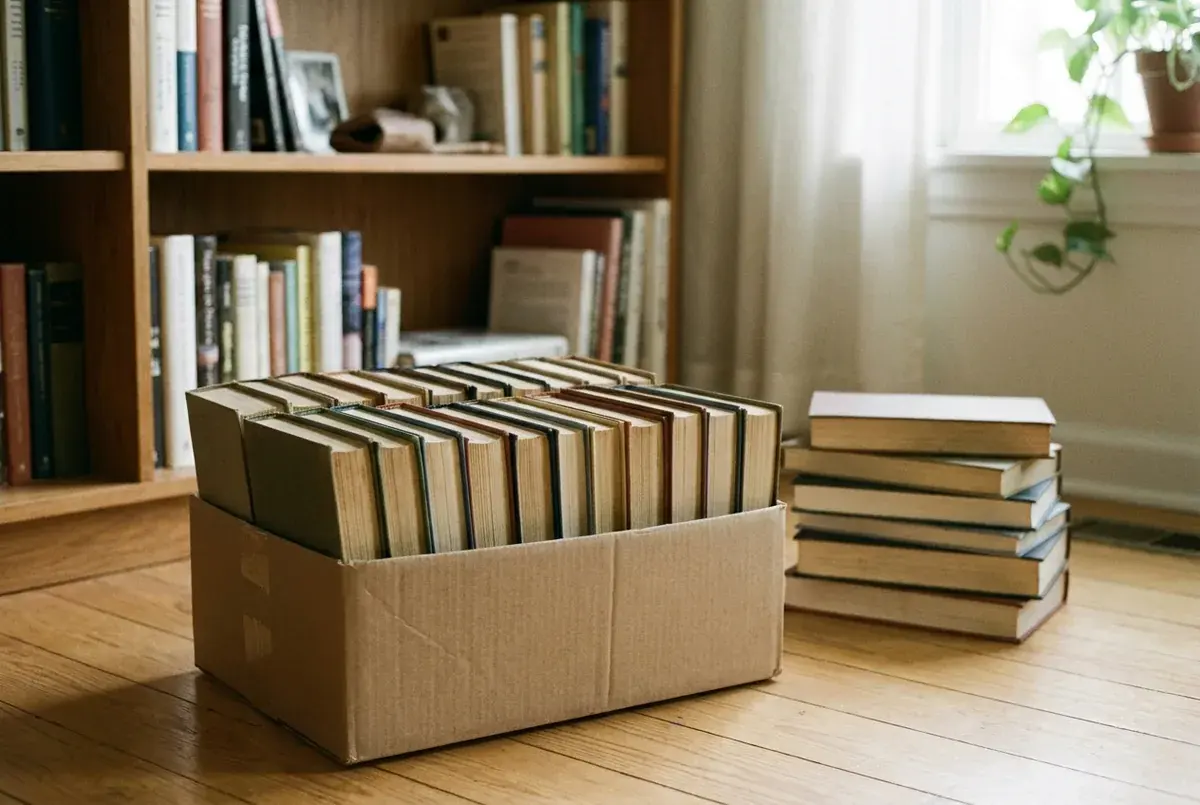
A shelf of books looks harmless. A box of them does not. Hardcovers run roughly twenty pounds per cubic foot, which makes them denser than almost anything else in the house, furniture included. Sofas are mostly air. Books are not.
That single number explains every rule that follows. The carton that blows out on moving day is almost never the one holding the lamp, and the spine that arrives warped almost never got that way from the truck ride. Both failures are decided before the tape goes on.
Libraries come in every size: three shelves in a North Park apartment, floor-to-ceiling studies behind Del Mar hedges, military shipments where every pound is accounted for. This is the process, written out, so you can run it yourself.
Start with the arithmetic, not the tape
A small book carton holds about 1.5 cubic feet. Fill it with hardcovers and you land between thirty and forty pounds. That is honest work for one person, down one flight, without negotiating.
Fill a medium carton with the same books and you are at seventy pounds. At that point it stops being a box. It becomes a two-person problem with a bottom that is already flexing, and the person carrying the low end is walking backwards down stairs.
So: small cartons, and more of them than you think you need. Consolidating into fewer large boxes is the most common packing mistake we see, and it is the one that ends with a paperback avalanche halfway down a steep driveway.
If you are reusing free boxes from a store, check the manufacturer's stamp on the bottom flap. Produce boxes are built for one trip and a cold room, not for stacking six high in a truck.
Small book carton
16 x 12 x 12 in · 1.5 cu ft · 30-40 lb when full
Medium carton
18 x 18 x 16 in · 3.0 cu ft · paperbacks only, stop at 50 lb
Large carton
18 x 18 x 24 in · 4.5 cu ft · pillows and lampshades, not books
File / banker box
24 x 12 x 10 in · 1.7 cu ft · tape the bottom, the lid is not a seal
Dish barrel
18 x 18 x 28 in · 5.2 cu ft · double wall, for oversized art books, filled halfway
Packing tape
2 in wide, 55 yd roll · roughly 20 book cartons per roll
Cull first, because books are the one category where it pays
Most of what you own, you move because you own it. Books are different. They accumulate long after the reason for acquiring them has expired, and every one of them has to be lifted twice.
Work one shelf at a time, with three destinations and a hard rule for each so you are not relitigating individual titles at eleven at night. Keep the piles physically separate from the first shelf onward.
If you are moving on military orders out of Coronado or Miramar, this step is not optional. Books are the fastest way to consume a weight allowance. Talk to your transportation office before you pack, and ask specifically how professional books and reference material are counted, because that answer can change what you box and what you carry.
- Rehome: duplicates, superseded textbook editions, and anything you kept because it was assigned rather than because you read it
- Rehome: manuals and cookbooks for appliances you no longer own
- Recycle: water-stained paperbacks, cracked glue bindings, and anything with a broken text block that no one will buy
- Keep: reference you actually open, anything signed or inscribed, and anything out of print
- Keep: the shelf of books you have not read yet, but count it honestly and box it separately
- Your branch library's Friends group will usually take clean donations, and used bookstores will quote you faster if you call ahead with a rough count
- Little Free Libraries absorb paperbacks in ones and twos, not in banker boxes
The three positions, and the one that ruins a binding
There are exactly two correct ways to put a book in a box, and one way that quietly destroys it.
Flat is the strongest. Lay books down in stacks, alternating spine direction each layer so the stack stays level instead of leaning toward the thicker edge. Upright is the fastest. Stand books the way they sat on the shelf, with the spine flat against the box wall and the fore-edge facing in, exactly as a library packs them.
Never pack a book spine-up with the fore-edge down. Under its own weight the text block sags away from the binding, and by the time it reaches the new house the pages have pulled forward into a permanent curve. Glue-bound paperbacks are the worst offenders. A week in a box in that position is enough to split one.
Before any of that, deal with the surfaces. Dust jackets come off and travel flat between two boards, or into a mylar sleeve if the book is collectible. Leather and vellum get wrapped individually in acid-free tissue or unprinted newsprint, never in plastic wrap or bubble against the hide, which sweats and blooms mold. Gilt edges take tissue too, because they scuff against a neighbor's cover.
- Flat stacking: strongest, best for heavy hardcovers and oversized art books
- Upright with spine to the box wall: fastest, and preserves shelf order for unpacking
- Spine-up with fore-edge down: never, on any book, for any length of time
- Unprinted newsprint only, never actual newspaper, which transfers ink onto page edges and cloth covers
- Acid-free tissue for leather, vellum, gilt edges, and anything you would be upset to replace
Packing is a service, not a weekend.
Our crews wrap, box and label the whole library. Veteran-owned, 10,000+ moves, 5.0 on Google.

The pack, step by step
The sequence below takes about four minutes per box once you have a rhythm, and it is the difference between a carton that stacks and a carton that bows.
One detail worth its own line: nothing inside the box should be able to slide. A book with an inch of travel will round its own corners against the cardboard over the length of a move. Fill voids with crumpled paper until the box is firm when you press the top, not springy.
- Tape the bottom in an H-seal: one strip down the center seam, one across each end seam, each strip running two inches up the sides
- Line the bottom with two crumpled sheets of packing paper, about an inch of cushion
- Load the largest and heaviest volumes flat on the bottom, covers squared to the box walls
- Build upward in layers, or stand the rest upright with spines against the wall, keeping like sizes together
- Slip a sheet of paper between layers of fine bindings so nothing rubs
- Cushion the top, close the flaps, and check that the lid sits flat: a bulge means it will not stack, a hollow means it will crush
- Tape the top with the same H-seal, then lift it by the bottom edges as a final test before it joins the stack
Estimating boxes, materials, and time
Measure your shelving in linear feet before you order anything. A tape measure across the front of each shelf, added up, is a better predictor than counting titles.
Order fifteen percent more small cartons than the math suggests. Flat, unused cartons cost less than a second supply run on the day you are trying to load a truck.
Photograph every shelf before you empty it, left to right, with your phone. Ten seconds per shelf now saves an evening later, and it is the only reliable way to rebuild a wall of books in the order you had it.
- Small cartons, a tape gun, and 2-inch packing tape (skip the dispenser-free rolls, your thumbs will not survive twenty boxes)
- Military PCS moves out of Coronado, Miramar or up toward Pendleton follow the same rule with one addition. If you are flying ahead of your household goods, the jewelry goes in the carry-on, never a checked bag, and the inventory photos need to be in your phone and your email rather than on a laptop that is crossing the country in a crate. PCS dates also land on weekends and holidays with some regularity. We run 24/7 including holidays, so that is a schedulable day: (858) 733-0775.
- Acid-free tissue for leather, signed copies, and gilt edges
- Gallon zip bags and a few silica gel packets for anything valuable making a coastal move
- A wide-tip marker, and a hand truck with a strap if you have more than about fifteen boxes
- Mylar or polypropylene jacket covers for collectible dust jackets
- Two boards cut to size to keep loose jackets and maps flat in transit
One linear foot of shelf
roughly 10 hardcovers or 14 paperbacks
One small carton
2 to 3 linear feet, about 20-25 hardcovers
A 36 in shelf
1 to 1.5 small cartons
A five-shelf bookcase
5 to 6 small cartons
A 30 ft wall of shelving
12 to 15 small cartons
Order overage
add 15 percent to whatever the math says
San Diego adds its own variables
Heat is the first one. A sealed box truck parked in the sun in El Cajon or Santee in August gets hot enough to soften adhesive bindings, and a car left at a trailhead is worse. Books should be among the first things loaded and the first things unloaded, and they should never wait out an afternoon in a vehicle.
Salt air and the marine layer are the second. In Point Loma, Ocean Beach and Coronado, a garage is not storage. Concrete slabs sweat, and a carton sitting directly on one wicks moisture up through the bottom flaps within days. If books are going into a garage even temporarily, get them onto a pallet or a shelf, and put silica in with anything you care about.
The third variable is access, and it changes what size box you should have bought. Streets in La Jolla and the Bird Rock grid do not accommodate a large truck near the door, and the driveways that do exist are often too steep to hand-truck a seventy-pound carton back up. A long carry from a shuttle vehicle is exactly the scenario where small cartons stop being a preference.
High-rise buildings in Mission Valley and downtown add a clock. Most require an elevator reservation, a certificate of insurance on file, and a loading dock window measured in hours. Book boxes are the reason that window gets missed. A hand truck takes six or seven small cartons per trip and only three large ones, so the smaller box is also the faster one.
- Load books low and forward in the truck, against the front wall, where they will not compress lighter goods
- Keep cartons out of direct sun during staging, especially inland in summer
- Never set book boxes on a garage slab, coastal or inland
- Reserve the freight elevator and confirm the COI requirement a week ahead in Mission Valley and downtown buildings
- In La Jolla and Del Mar, walk the route from the curb to the door before you decide on box sizes
- Label every carton with room, contents, shelf sequence, and the word HEAVY on two sides
- For a PCS move, box professional reference material separately and keep its inventory clean
Stairs and long carries are in the quote.
No mileage, no fuel surcharge, and the stairs priced in the survey. Give us the address and the quote holds, 24/7 including holidays.
The day you unpack
Books are the one category worth unpacking last, unless the room in question is an office. Everything else has to be functional first, and a wall of books goes up quickly once the shelving is standing.
There is one exception. If any carton was exposed to heat or sat somewhere damp, open it within a day or two. Let the books sit in a conditioned room before they go back on the shelf, standing loosely with air between them. A book that gets shelved tight while it still holds moisture is a book that cups.
Shelve with a small gap between the back of the books and any exterior or garage-facing wall, which is where condensation forms first. If a volume has warped, press it flat between two boards under even weight for a week before deciding it is ruined. Most recover.
Then break the cartons down and get them out of the house. Corrugated cardboard is food for silverfish, and silverfish will find their way from the flattened stack in the garage back to the shelf you just rebuilt.
What to remember
- Small cartons only. Roughly 1.5 cubic feet, thirty to forty pounds, and no exceptions for hardcovers.
- Flat stacks or spines against the box wall. Never spine-up with the fore-edge down, which sags the text block away from the binding.
- Photograph each shelf and number the boxes in shelf order. Rebuilding the wall then takes an hour instead of a weekend.
- Heat and coastal damp do the real damage, not the truck ride. Keep cartons out of parked cars and off garage slabs.
- Cull before you box. Books are the fastest way to add weight to a move, and on a PCS shipment that weight comes straight off your allowance.
Get it priced to the dollar.
No fuel surcharges. Stairs are in the quote. No hidden anything. The quote is the price, 24/7 including holidays.
About twenty to twenty-five hardcovers, or thirty to forty paperbacks, which works out to roughly two to three linear feet of shelf. A standard 36-inch shelf is one to one-and-a-half cartons. Measure your shelving in linear feet and divide by two-and-a-half for a reliable count, then add fifteen percent.
You can, with two caveats. Check the box maker's certificate on the bottom flap for the burst strength rating, and skip anything that has been through a cold room, since damp corrugate loses most of its stacking strength. Mismatched sizes also stack badly in a truck, which matters more than people expect. If you use them, H-seal the bottom with real 2-inch packing tape and cap each one at forty pounds.
Rolling suitcases are genuinely one of the better tricks, because the wheels carry the weight instead of your back. Fill them halfway, lay books flat, and stop when the handle still extends easily. Plastic bins are the weaker option: their lids are not load-bearing so they cannot be stacked safely, and they trap humidity against paper, which is the wrong choice anywhere near the coast.
Wrap each one in acid-free tissue, box them separately from the general library, and mark that carton so it is not stacked under anything. Anything irreplaceable should ride in your own vehicle. Flexdolly carries $1M liability and $100K cargo coverage, and we are licensed and insured under USDOT #4329208, but replacement value and irreplaceable are two different things. Tell your crew lead what is in the box before the truck loads.
Not with us. No fuel surcharges, no hidden fees, and the stairs priced in the survey. The quote is the price. Typical local moves land between $400 and $600 for a small job, $600 to $1,000 for a one- or two-bedroom, and $1,000 to $1,400 for a larger home. We are veteran-owned, hold a 5.0 rating on Google, and we run 24/7 including holidays. Call or text (858) 733-0775.