Packing
How to Pack Dishes for Moving: Protect Your Fragile Items
A dish barrel, a stack of unprinted paper, and one counterintuitive rule about how plates ride in a box. Here is the method our crews use on San Diego kitchens.

Breakage almost never happens the way people picture it. Dishes rarely shatter because somebody dropped a box. They crack because the box was packed loose and then spent forty minutes vibrating up the 5, or because the plates were stacked flat and the weight of the stack worked steadily against the flattest, weakest part of each plate.
The fix is mostly free. Paper, a sturdier box than you think you need, and one rule about orientation. The kitchens that arrive intact are the ones packed by someone who understood what happens between the two addresses, not the ones packed fastest.
What follows is the method, step by step, plus the parts that are specific to moving here: the August heat in a closed garage, La Jolla driveways, the freight elevator window downtown that is shorter than the building told you.
Start with the box, not the plate
The box is the part people economize on, and it is the part doing the structural work. A dish barrel, also called a dish pack, is double-wall corrugated: two fluted layers instead of one. It resists crushing when something gets set on top of it in the truck, and it keeps its shape when a hand truck tips back on a steep driveway.
Used boxes are a false economy for dishes specifically. Corrugation is a spring, and once it has been compressed on somebody else's move it does not fully recover. A box that carried books last year will carry books again. It should not carry your grandmother's plates.
Plastic bins are the other common mistake. They flex, the lids do not lock the contents down, and they do not stack squarely against cardboard, which means they end up wedged into odd corners of the load. Liquor-store boxes and banker's boxes have handholes, and a handhole is an opening, and an opening is where a corner fails.
Dish barrel (dish pack)
18 x 18 x 28 in, about 5.2 cu ft, double-wall
Small box (book box)
16 x 12 x 12 in, 1.5 cu ft, for flatware and small pieces
Medium box
18 x 18 x 16 in, 3.0 cu ft, for pots and mixing bowls
Cell divider kit
Drops into a dish barrel, 12 to 24 cells for stemware and mugs
Wall spec that matters
Double-wall corrugated, roughly 1/4 in thick
Weight ceiling, any box
50 lb; a correctly filled dish barrel lands near 45
The materials, in quantities that actually cover a kitchen
Unprinted newsprint is the whole game. It is sold by weight, it crumples into something springy rather than something flat, and it does not transfer ink. Newspaper transfers ink onto glazed ceramic and into unglazed stoneware bottoms alike, and scrubbing it off two hundred pieces at the far end of a move is a specific kind of misery.
Buy more paper than your estimate. Under-protected boxes almost always come from rationing paper somewhere around the last third of the kitchen. Paper is the cheapest line item in the entire move and the only one that is standing between a plate and the road.
Clear one full flat surface before you begin. The island, the dining table, or a counter stripped down to nothing. Wrapping dishes on a crowded surface is how chips happen before a box is even sealed.
- Unprinted newsprint, roughly 5 to 7 lb per dish barrel
- Small-bubble wrap for stemware and anything with a handle or a spout
- Foam pouches for glasses, if you would rather not learn the diagonal wrap
- Acid-free tissue for china with gold or platinum rims
- Felt or foam plate separators for a service you intend to keep for decades
- A chisel-tip permanent marker, not a ballpoint
- Two-inch packing tape and a tape gun, one roll per eight to ten boxes
Studio or 1BR kitchen
1 dish barrel, 1 small box, about 10 lb paper
2BR kitchen
2 dish barrels, 1 to 2 small boxes, about 15 lb paper
3 to 4BR family kitchen
3 to 4 dish barrels, 20 to 25 lb paper, 1 cell kit
Formal china service for 12
1 dedicated dish barrel, tissue plus separators
Stemware, per 12 glasses
1 cell tier, about 5 lb paper or 12 foam pouches
Spare capacity
One more dish barrel than you think, always
The wrap: plates ride on edge, never flat
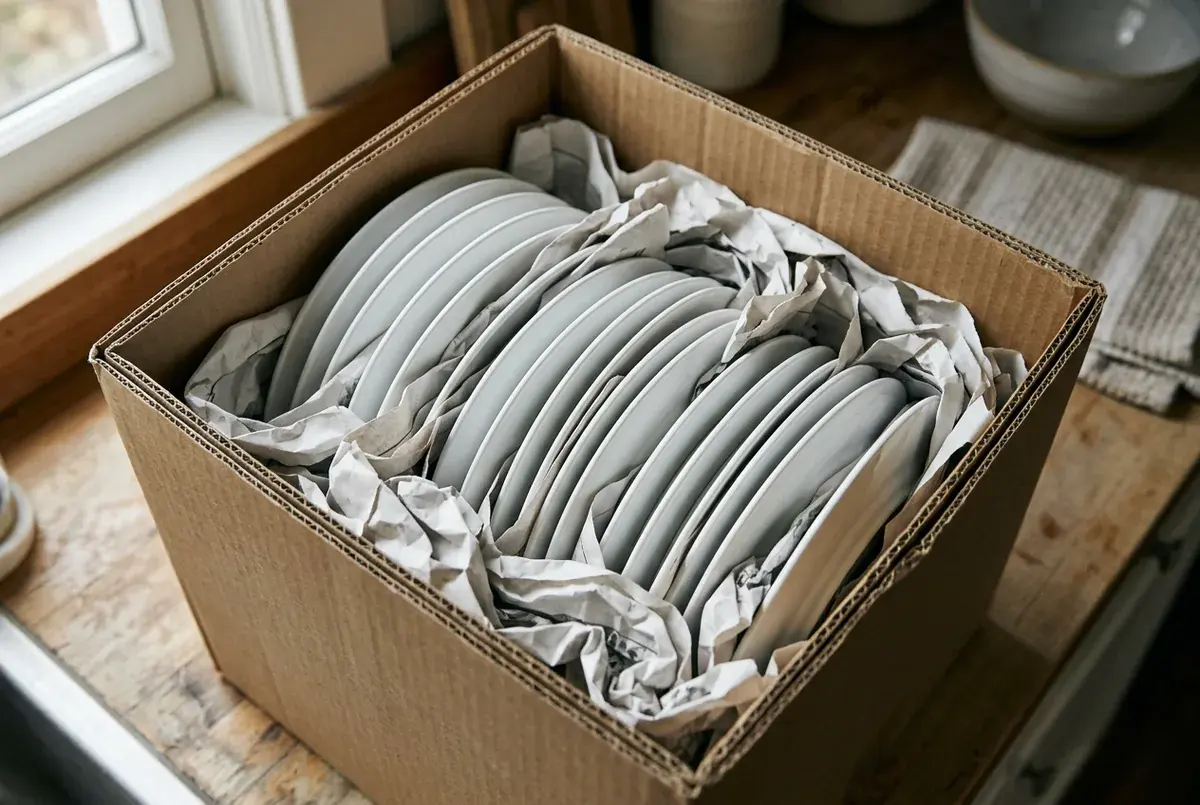
If you take one thing from this article, take this. Plates go into the box standing on edge, vertically, the way records sit in a crate. They do not lie flat in a stack.
A plate is strongest through its rim and weakest across its face. Stack six plates flat and every seam in the road drives the weight of the whole stack through the unsupported center of the bottom one. Stand those same six on edge and the load runs down through the rims, which is the geometry the plate was fired to handle. Flat-stack breakage has a signature: a crack radiating outward from the middle of the bottom plate. Once you have seen that crack, you stop stacking plates flat for anything, ever.
The wrapping itself is a rhythm. It feels slow for the first ten plates and then it is not slow at all.
When the box is full and closed, lift one side and tilt it. If you hear or feel anything move inside, open it and add paper. A finished dish box should behave like a solid block, not like a box with things in it.
- Build the base: four inches of loosely crumpled paper in the bottom, pressed until it springs back rather than flattens.
- Lay a sheet of paper flat and set one plate slightly off-center, nearer one corner.
- Pull that corner over the plate, set a second plate on top, pull the next corner, and continue until three or four plates are bound into one bundle.
- Tape the bundle once, lightly, so it opens later without a fight.
- Stand the bundle in the box on edge, on its rim, not on its face.
- Pack crumpled paper down the sides until the bundle cannot be nudged with a finger.
- Top with two inches of paper and close the flaps. If the lid bows inward when you press it, add more; if it bulges upward, take some out.
Hand the kitchen to a crew.
Packing, paper and boxes, priced up front. Materials and stairs priced in the survey, so there are no surprises when the truck is loaded.

Stemware, mugs, and the pieces that break even when you do everything right
Glasses fail at the stem and at the rim, and both failures trace back to the same thing: the wall of the glass flexing inward with nothing behind it. So you fill the glass first. A loose twist of paper pushed into the bowl of a wine glass turns a thin shell into a supported one, and it costs you three seconds.
Then wrap on the diagonal. Start at the base, roll up and over the rim, and tuck the tail down into the bowl. A glass wrapped flat, side to side, leaves the rim exposed at both ends of the roll, which is exactly where chips come from.
Mugs are the sleeper problem in most kitchens. The handle is a cantilever, held on by nothing but the clay's own bond, and it is the first casualty of a loose box. Wrap the handle by itself, then wrap the whole mug, and put no more than two mugs on a sheet.
Load heaviest to lightest, bottom to top: dinner plates on the deck of the box, bowls and salad plates in the middle, stemware and mugs in a cell tier on top. Nothing in the kitchen justifies inverting that order.
- Push a loose twist of paper into the bowl of every glass before you wrap the outside.
- Wrap glasses on the diagonal, base to rim, tail tucked inside.
- Wrap each mug handle separately, then the whole mug. Two mugs to a sheet, maximum.
- Stemware stands upright in cells. Laid on its side, the stem carries the load, and the stem always loses.
- Take the lid off every teapot, pitcher and tureen. Wrap it separately and pack it in the same box.
- Never tape directly onto a glazed, painted or gilded surface. Tape lifts finish on the way off.
- Fill every void. Empty space inside a dish box is the only thing that actually breaks dishes.
China, crystal, and the cabinet nobody has opened since the nineties
Del Mar estates and the older homes along the coast tend to produce the same box: formal china that has sat untouched in a butler's pantry or a lighted cabinet for decades. The first instinct is to wash it. Do not wash it now. A plate that is even slightly damp will bond to packing paper over a two-day move, and separating them takes gilding with it. Dust it dry, pack it, wash it in the new house.
Military PCS moves out of Coronado, Miramar or up toward Pendleton follow the same rule with one addition. If you are flying ahead of your household goods, the jewelry goes in the carry-on, never a checked bag, and the inventory photos need to be in your phone and your email rather than on a laptop that is crossing the country in a crate. PCS dates also land on weekends and holidays with some regularity. We run 24/7 including holidays, so that is a schedulable day: (858) 733-0775.
Crystal is heavier and softer than everyday glass, and lead crystal tends to chip at the rim rather than crack through the body. Treat chargers and large platters like plates: upright, on edge, in the tallest box that lets them stand without leaning.
Photograph the set laid out before anything is wrapped, count the pieces, and write the count on the box. If something is genuinely irreplaceable, say so before packing starts rather than after the truck is loaded. We are licensed and insured, USDOT #4329208, carrying $1M liability and $100K cargo coverage, and every version of that conversation is easier while the piece is still in the cabinet.
Labeling, and where dish boxes ride in the truck
Label two adjacent sides and the top. Not one side. By some reliable law of the universe, the side you wrote on is the side that ends up facing the wall.
Write the room the box is going to, not the room it came from. If the new kitchen is upstairs and the old one was not, a box marked only KITCHEN gets carried to whichever kitchen the loader can see, and heavy dish barrels are the worst boxes to move twice.
FRAGILE on its own tells a loader nothing they can act on. DISHES, with an up arrow, tells them orientation, and orientation is the only instruction that matters for a box packed on edge.
In the truck, dish barrels belong on the deck against a wall, in a single tier, strapped, with light soft goods above them and nothing heavy at all. They stay off the tail, where the ride is roughest.
- Two adjacent sides plus the top, in chisel-tip marker.
- Contents, destination room and an up arrow on every dish box.
- Number the boxes and keep the count on your phone. Fourteen of thirty-eight is a fact; most of them is not.
- Dish barrels ride on the deck, against a wall, strapped, single tier.
- Nothing heavy on top of a dish barrel, ever. Soft goods only.
- Keep the dish boxes forward, away from the tail of the truck.
- Load the first-night box last so it comes off first.
The loading is the other half.
Deck level, single tier, strapped and labeled by a veteran-owned crew rated 5.0 on Google.
The San Diego part
Heat is the variable people forget. August in Santee, Mira Mesa or El Cajon turns a closed garage into something well past the outside temperature, and a parked truck is worse than the garage. Two things follow from that. Tape adhesive softens, so a seam taped in a hot garage can creep open under load. Re-press every seam on move morning with a firm hand. And sealed dish boxes should never be staged in a car sitting in the sun while you go back for a second load.
La Jolla is a carry problem. The streets are narrow, the driveways are steep, and there is frequently no straight line from the curb to the door. Longer carries mean more handling and more set-downs per box, and a hand truck coming down a steep drive rides at an angle the whole way. Vertical plates are what survive that. Stairs are ordinary in these neighborhoods, and they are counted in the survey rather than charged as a penalty, so nobody on the crew has any reason to hurry a flight.
Downtown and Mission Valley high-rises run on the freight elevator, and the reservation window is real. Book it as early as the building allows, ask how long the window actually is rather than assuming, and get the dish boxes off the truck early instead of leaving them on a loading dock through the hottest part of the afternoon. Inside the elevator they go flat on the floor, not stacked on a pile.
PCS moves out of Coronado and Miramar have their own rhythm. Photograph and count everything before it is wrapped, note it on your inventory, and if the shipment is heading into storage, use paper rather than newspaper and do not seal ceramics into an airtight bin with any moisture in it. Orders change and dates move with them. Flexdolly is veteran-owned, our founder Nas is a U.S. Army veteran, and we run 24/7 including holidays, which tends to be the part that matters when a report date shifts.
What to remember
- Plates ride on edge, standing like records in a crate. Flat stacks crack from the center of the bottom plate outward.
- A dish barrel is double-wall for a reason. A used grocery box is not a substitute and neither is a plastic bin.
- Four inches of crumpled paper below, two inches above, every void filled. Tilt the closed box; if anything moves, open it.
- Ink transfers. Use unprinted newsprint, and put acid-free tissue against any gold or platinum rim.
- Label the destination room on two adjacent sides and the top, because one side always ends up facing the wall.
Get it priced to the dollar.
No fuel surcharges. Stairs are in the quote. No hidden anything. The quote is the price, 24/7 including holidays.
A one-bedroom kitchen usually fits into one dish barrel plus a small box. A family kitchen with everyday dishes and a formal service runs three to five dish barrels. Buy one more than your estimate. An under-filled box is a two-minute fix; an overfilled one is a decision you make at 9pm with nothing left to put things in.
They are fine for filling the last inch of space, but they should not be the thing separating your plates. Paper crumples into a spring that pushes back. A folded towel behaves like a shim: it compresses under load, and once it has compressed the contents have room to move. Use linens as filler, not as protection.
The kitchen is the room where packing hours and breakage risk are both highest, which is why it is the room most people hand over. Our crews do it in a fraction of the time a household takes, and the quote is the price: no fuel surcharges, no hidden fees, and the stairs already counted. We hold a 5.0 star rating on Google, and we work across San Diego County.
Typical local moves land between $400 and $600 for a small move, $600 to $1,000 for a one or two bedroom, and $1,000 to $1,400 for a larger home. Dishes rarely change that figure. What they change is how long the pack takes, which is worth mentioning when you call: (858) 733-0775.
Three to five days out. Then set aside a first-night box: four plates, four bowls, four mugs, one pan, one knife, one cutting board. Tape it shut, mark it clearly, and make sure it is the last thing loaded so it is the first thing off. The alternative is opening four dish barrels at 11pm looking for a coffee cup.