Packing
How to Properly Pack Paintings for a Stress-Free Move
Glass, gilding and bare canvas each fail in a different way. Here is the order of operations that gets art from one wall to the next without a new scratch.

A painting is the one thing in your house that can survive a move looking perfect and still be ruined. The frame holds. The glass holds. Then you hang it in the new place, tilt it toward the window, and there it is: a shallow crease across the sky, or a faint bloom where plastic sat against varnish in a warm truck.
Most art damage does not come from a dramatic drop. It comes from the ninety seconds when someone leans a canvas against a stucco wall, from the hour a box spends face-up on a Clairemont driveway in August, or from two unwrapped frames sliding into the same gap in the truck until the corner of one finds the surface of the other.
What follows is the sequence that prevents all three. A normal wall's worth of art takes an afternoon, less if you sort first. None of it needs a workshop. Most of it only needs you to do things in the right order.
Sort the art before you buy a single roll of tape
Art is not one category. It is four or five, and each one fails differently, which means each one gets different materials. The most common packing mistake is buying one kind of wrap and applying it to everything. Bubble wrap is exactly right against glass and exactly wrong against bare oil paint.
Sort first, then shop. Walk the house with a notepad and put every piece into one of the groups below, writing down the outer frame dimensions as you go. Those dimensions decide your box sizes, and box sizes are the part people get wrong at the store.
Then photograph everything before anything gets wrapped. Front, back and all four corners, in daylight, with the camera held at a raking angle so the light skims across the surface and reveals dings that a straight-on photo hides. Shoot the back too: hanging hardware, gallery labels, any conservation notes. If a question ever comes up later, raking-light photos taken on packing day settle it in about four seconds. While you are there, photograph the wall as currently hung so you can rebuild the arrangement instead of reinventing it.
- Glazed: anything behind glass or acrylic. The hazard is breakage, and then the shards.
- Unglazed: oil, acrylic or encaustic on canvas or panel. The hazard is anything at all touching the surface.
- Works on paper: prints, watercolours, photographs, documents. The hazard is moisture, pressure and creasing.
- Ornate and antique: gilding, gesso, carved plaster, compo. The hazard is pressure on the ornament itself.
- Oversized: anything past about five feet on the long side, or anything that needs two people to lift. The hazard is flex.
The materials list, and the one item people skip
All of this is available at any moving supply or hardware store. Buy about a third more than your count suggests. Running out of corner protectors at nine at night is a genuinely annoying way to lose an evening.
The item nearly everyone skips is glassine: a smooth, semi-translucent, non-absorbent paper. It is the only thing that should ever touch a bare painted surface or an unsealed sheet of paper. It resists moisture and it will not lift varnish or take on the texture of the material pressed against it, which is precisely what thin plastic does when a truck gets warm.
Two things never go near art. Newsprint, because the ink transfers, especially onto acrylic glazing and unsealed paper. And kitchen plastic wrap, because it clings to exactly the surfaces you are trying to protect.
Glassine paper
36 in roll; the barrier layer against bare paint and unsealed paper
Mirror carton, telescoping four-piece
Adjusts to roughly 40 x 60 in; the default for framed work
Small picture box
About 30 x 40 x 3.5 in; fits most single framed prints
Foam corner protectors
Sized for frames up to about 1.5 in thick; four per piece, minimum
Bubble wrap, small bubble
3/16 in bubble; bubbles face outward, never toward the surface
Low-tack painter's tape
3/4 in; touches glazing only, never paint, gilding or paper
Wrapping, in the order that actually matters
The layering is not cosmetic. Each layer exists so that it fails before the layer underneath it does. Skip one and the next impact goes straight through to the surface.
One note on the tape X across glazing, because it is widely misunderstood. It is not there to hold the glass together. It is there so that if the glass does break, the shards stay put instead of sliding across the artwork like a squeegee. Never do it on acrylic glazing, where tape residue and static are a bigger risk than the breakage you are guarding against.
Match the box to the piece rather than to what is on the shelf. A frame rattling around inside an oversized carton is worse protected than the same frame in a snug box, because movement is the whole problem.
- Glazed work: run a low-tack tape X corner to corner across the glass. Skip this step entirely on acrylic.
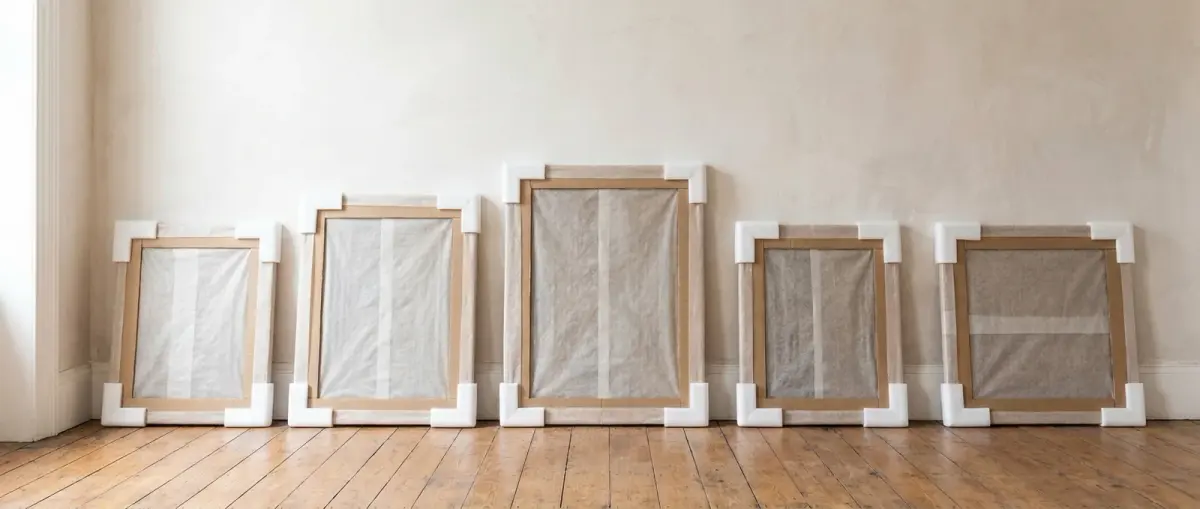
- Unglazed work: lay glassine over the face and tape it to the back of the frame. Tape never touches the surface or the canvas.
- Cut two pieces of corrugated cardboard or foam board to the exact outer dimensions of the frame and sandwich the piece front and back.
- Push a foam corner protector onto all four corners. Corners absorb almost every impact a moving box ever takes.
- Wrap in bubble with the bubbles facing out, and tape the bubble to itself. Tape never touches the frame.
- Slide it into the box standing on its long edge, shim any gap with crumpled paper so nothing can slide, then tape every seam.
- Label the top edge and one face: fragile art, an up arrow, the destination room, and the wall if you already know it.
Up to 24 in on the long side
Small picture box, or two pieces face to face with foam board between
24 to 40 in
Single mirror carton
40 to 60 in
Telescoping four-piece mirror carton
Over 60 in, or a heavy ornate frame
Crate, or a blanket over a rigid panel carried by two people
Anything you would not want to replace
Crate it, regardless of size
Wrapped by people who do it daily.
Our packing crew wraps the fragile third of the house on site. Materials and stairs are priced in the survey, and that price is guaranteed before we book.

The pieces that break the rules
Six categories need something other than the standard sequence, and they are the six that most often arrive damaged because they were treated as standard.
If a piece falls into more than one of these groups, treat it as the more fragile of the two. An ornate gilded frame around an unglazed oil is not a picture-box job. It is a crate.
- Gilded and ornate frames: gilding is metal leaf a fraction of a micron thick over brittle gesso. Bubble wrap under tension prints its pattern into it, and pressure on a carved corner crushes the gesso off. Loose acid-free tissue first, then a soft blanket, then build the rigid layer outside all of that. Never compress.
- Unframed stretched canvas: the back is as vulnerable as the front. A thumb through the reverse of a canvas is a conservator's visit. Sandwich it between two rigid boards cut larger than the stretcher, with spacers so nothing contacts either face.
- Works on paper: framed, keep them rigid and fully supported, and pack them upright like any other framed piece. Unframed, flat in a portfolio between acid-free boards beats a tube every time. If you must roll, use a tube at least four inches in diameter, roll image side out, and interleave with glassine.
- Acrylic glazing: it scratches from almost anything, including its own dust. Clean with a soft microfiber before packing, never paper towel, never an ammonia glass cleaner.
- Diptychs, triptychs and gallery walls: photograph the arrangement, then number the backs with removable labels. Reassembly is the part everyone underestimates and nobody budgets time for.
- Hanging wire left attached: it will saw into whatever is stacked behind it. Tape the wire flat to the back or remove it and bag the hardware to the frame.
Loading day in San Diego
Heat is the local variable people underestimate. A closed box truck sitting in the sun on a Kearny Mesa lot turns into an oven, and heat is exactly what converts wrapped-in-plastic from harmless into a bonded mess on a varnished surface. Art loads last, unloads first, and does not spend a summer night in the truck.
Coastal humidity is the second one. An unconditioned garage in Ocean Beach or Point Loma swings hard between a damp night and a warm afternoon, and glazing sweats in that swing. Do not stage art in the garage the evening before. Keep it inside the conditioned house until the truck is actually at the curb.
Inside the truck, art rides upright on its long edge, flat against a wall, strapped. Never lying down, never with anything stacked on it, never wedged where a mattress can slump into it over the course of a drive up the 5.
Access is the rest of the story, and in this county access changes street by street.
- La Jolla: narrow lanes, driveways steeper than a ramp likes, and long carries from wherever the truck legally fits. Art travels in two hands on a dedicated trip, never on the dolly stack.
- Del Mar and Rancho Santa Fe: long driveways and split-level entries mean more stairs than the walkthrough suggested. Flexdolly charges stairs counted in the quote, so nobody has a reason to rush that carry.
- Mission Valley, Little Italy and downtown high-rises: reserve the freight elevator, confirm the loading dock window, and get the certificate of insurance to building management ahead of the day. Flexdolly is licensed and insured under USDOT #4329208 with $1M liability and $100K cargo, which is what a building is asking for when it requests a COI.
- Coronado and Miramar PCS moves: small irreplaceable pieces belong in your own vehicle, not in any truck. For everything else, the photo inventory matters more than usual.
- North Park, Normal Heights and South Park: street parking is tight and the walk can run half a block. Decide where the truck actually fits before load day, not at eight in the morning.
- Any summer move: the last thing into the truck should be art, and the first thing out should be art.
Unpacking, and getting it back on the wall
Do not open art boxes the moment they land. Let them sit indoors for a few hours so the contents reach room temperature. Glazing that comes out of a warm truck straight into an air-conditioned room will condense, and condensation behind glass is a conservation problem rather than a paper-towel problem.
Then unpack art before you unpack anything else, and inspect each piece against the photos while the crew is still on site. Damage found on day one is a conversation. Damage found in October is a story.
While you are sorting, do not lean unwrapped art against a wall. Leave the cardboard sandwich in place, face every piece the same direction, and put a folded blanket under the bottom edges. Then hang according to what is actually behind your drywall, because San Diego housing stock varies enormously and the wrong anchor is how a piece survives the entire move and then falls on a Tuesday.
- Lath and plaster, common in North Park, Kensington and South Park bungalows: pilot-drill, never hammer a nail cold into plaster.
- Drywall over wood studs: stud finder and a picture hook. Past about twenty pounds, find the stud or use two rated anchors.
- Metal studs, common in newer high-rise interiors: toggle bolts, not screws driven into the channel.
- Stucco or masonry: masonry bit, plastic anchor, and hold a vacuum nozzle under the hole while you drill.
- Anything heavy or wide: a French cleat spreads the load across two points and lets you level it afterward.
Unloaded first, inspected with you.
5.0 on Google and 10,000+ moves, veteran-owned under USDOT #4329208, available 24/7 including holidays.
Where DIY stops paying for itself
There is a line where packing your own art stops saving money and starts costing it. It is not about confidence, it is about geometry and value: oversized pieces, heavy ornate frames, large glazed works, and anything that took a real decision to buy. Those belong in a crate built by someone who builds them regularly.
If you are not sure which side of the line a piece falls on, say so when you book. That conversation takes two minutes and it is the cheapest part of the entire move.
Flexdolly is veteran-owned and run by founder Nas, a U.S. Army veteran. Licensed and insured under USDOT #4329208, carrying $1M liability and $100K cargo. 5.0 stars on Google, 10,000+ families moved, and one county we know cold: San Diego. Available 24/7, holidays included.
No fuel surcharges. Stairs are in the quote. No hidden fees. The quote is the price. Anywhere in San Diego County, call (858) 733-0775.
Small local move
$400-600
1-2 bedroom
$600-1,000
Large local move
$1,000-1,400
What to remember
- Glassine against the surface, a cardboard sandwich around it, corner protectors on all four corners, then bubble facing outward. Plastic never touches bare paint.
- Photograph every piece front, back and corners at a raking angle before it is wrapped. It is the only record that survives a disagreement.
- Art rides upright on its long edge, loads last, unloads first, and never spends a summer night in the truck.
- Let boxes acclimate indoors for a few hours before opening glazed work, then inspect against your photos while the crew is still there.
- Oversized, heavy or irreplaceable pieces are a crating decision, not a bubble wrap decision. Raise it when you book.
Get it priced to the dollar.
No fuel surcharges. Stairs are in the quote. No hidden anything. The quote is the price, 24/7 including holidays.
Blankets protect against impact, not against pressure. A blanket over an unglazed canvas transmits a knee, a strap or the corner of another frame straight through to the paint. Use blankets outside the rigid layer, never as the rigid layer.
No. Deframing is a conservation task, not a packing task, and the frame is doing structural work for the piece inside it. The only exception is unframed works on paper you were already planning to reframe, which travel flat between acid-free boards.
Typical local moves land between $400 and $600 for a small move, $600 to $1,000 for a one or two bedroom, and $1,000 to $1,400 for a larger home. Dishes rarely change that figure. What they change is how long the pack takes, which is worth mentioning when you call: (858) 733-0775.
Call your building the same week you book the move. Most want the elevator reservation and the certificate of insurance in hand days in advance, many release the freight elevator only in specific windows, and a crew arriving without a COI on file usually does not get past the dock.
Yes. Flexdolly is available 24/7 including holidays, so an evening, weekend or holiday window is a scheduling question rather than a problem. Call (858) 733-0775 anywhere in San Diego County, and bring the building's window with you to the call.